
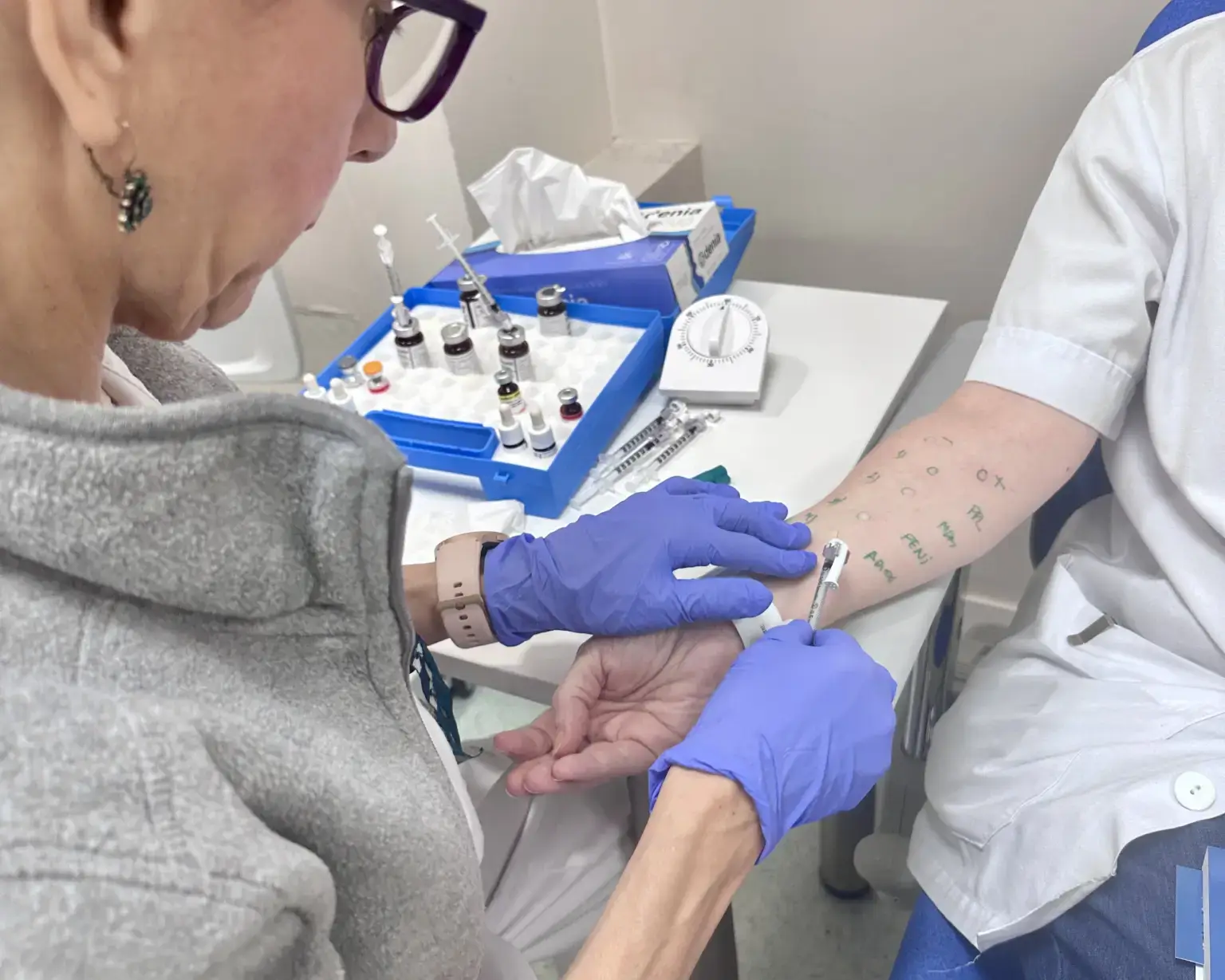
On the occasion of World Allergy Day, Hospital Clínic Barcelona highlights drug desensitization, a highly specialized procedure that allows patients with allergies to essential medications to continue receiving the most appropriate treatment for their condition.
Each year, the Drug Desensitization Team of the Allergy Department performs nearly 500 procedures of this kind. The goal is to prevent allergic reactions from forcing the discontinuation of first-line treatments for conditions such as cancer, severe infections, or complex cardiovascular diseases.
When a patient develops an allergic reaction to an essential medication, alternative treatments may be less effective, associated with more side effects, or more costly. In some cases, there may be no equivalent alternative available.
Drug desensitization involves administering the medication gradually, starting with very small doses and progressively increasing them until the full therapeutic dose is reached. This process induces temporary tolerance to the drug, allowing it to be administered safely. Before undergoing the procedure, each patient receives a comprehensive allergy evaluation to determine suitability and assess risk. The entire process is carried out under close clinical monitoring.
“When a patient develops an allergic reaction to an essential medication, desensitization allows us to continue administering the treatment they need rather than resorting to alternatives that may be less effective. The goal is to ensure that an allergy does not become a barrier to receiving the best therapeutic option available,” explains Dr. Sonia Gelis, allergist at Hospital Clínic Barcelona.
From 4 procedures per year to nearly 500 in just over a decade
The Drug Desensitization Team of the Allergy Department began its activity in 2012, when only four to five procedures were performed annually. Today, the team carries out nearly 500 procedures each year, reflecting both growing demand and the consolidation of this highly specialized activity.
This growth has been accompanied by significant advances in clinical protocols. During its early years, the team followed standardized models developed by leading international centers. Drawing on more than a decade of experience, however, the team moved towards a more personalized approach, adapting protocols to the characteristics of each patient and each medication.
Implemented from 2021 onwards, this approach has significantly reduced the duration of many procedures—from six to eight hours to just three to four hours—while improving safety and increasing the likelihood of successful treatment. Even today, this personalized model remains uncommon among leading referral hospitals.
“Hospital Clínic has incorporated increasingly personalized desensitization models. This evolution has enabled us to consolidate a high-volume program and position the hospital among the centres with the greatest experience in this field,” says Dr. Joan Bartra, Head of the Allergy Department at Hospital Clínic Barcelona.
Cancer treatments, antibiotics and cardiac procedures
Although desensitization can be applied to many medications, the team’s clinical activity focuses primarily on three areas.
Hemato-oncology
Hypersensitivity reactions to chemotherapy agents or monoclonal antibodies do not necessarily require interruption of the most appropriate treatment. Desensitization makes it possible to continue administering these drugs safely, offering many patients treated within the Clínic Barcelona Comprehensive Cancer Center (4CCC) an effective alternative.
Infectious diseases
In the case of antibiotics, desensitization enables the use of the most effective targeted treatment for a specific infection. This contributes to better clinical outcomes and aligns with antimicrobial stewardship strategies, while also supporting efforts to combat antimicrobial resistance.
Interventional cardiology
Another important area of activity is desensitization to acetylsalicylic acid (ASA) before certain interventional cardiology procedures. In these cases, the medication is essential to prevent stent thrombosis and ensure procedural safety. The team regularly receives referrals from other hospitals for this type of intervention.
Drug desensitization is a highly specialized activity that requires close coordination between allergists and the teams responsible for managing the patient’s underlying disease. This collaborative approach enables patients who have experienced allergic reactions to continue receiving treatments considered essential for controlling their condition.


