What is Epilepsy?
Epilepsy is a group of nervous system diseases caused by alterations in brain electric activity that lead to sudden symptoms, most of times with loss of consciousness that are called epileptic seizures. The term epilepsy comes from the Greek word “epilambaneim”, which means “catch by surprise”.
It is one of the most common neurological disorders and affects around 50 million people worldwide. To date, it continues to be a little-known illness and with a certain stigma that affects the social life of patients and their families.
Epilepsy explained in first person
With the medical treatment seizures are adequately controlled in almost 70% of patients.
You have to be brave, there’s a light at the end of the tunnel. Don’t be put off when they say “there is a 40% chance you’ll be fine, and a 60% you’ll be worse.” Out of 100%, I have a 40% chance of getting better. You have to weigh up the pros and cons, and the pros are always better than the cons.

Epileptic seizures are the result of excessive neuronal activity that induce sudden, loss of consciousness, temporary alterations in perception, behaviour or mobility. The symptoms associated with a seizure depend on the group of neurons activated during the episode.
Types of Epilepsy
Seizures are classified as either acute symptomatic seizures if they arise during a traumatic brain injury (e.g., during a stroke), or unprovoked seizures, when there is no underlying transient factor.
There are two main types of epilepsy:
- Generalised seizures. These are due to excessive activity in neural networks located in both hemispheres of the brain. They are classified as:
- Motor:
- Tonic. These are associated with a loss of consciousness, and the whole body goes stiff.
- Tonic-clonic. Characterised by a loss of consciousness, muscle stiffness and muscle jerks.
- Myoclonic. Rapid, whole-body short-lasting muscle jerks.
- Atonic. A loss of muscle control, possibly leading to sudden falls.
- Non-motor:
- Typical and atypical absence seizures. Characterised by brief periods (seconds) of unconsciousness and staring blankly, this could occur repeatedly.
- Motor:
- Focal seizures. These originate in neural networks located in just one hemisphere of the brain. They are classified as:
- Focal aware seizures. They can affect movement, sight, hearing, memory, speech or feeling, but the patient remains conscious.
- Focal impaired awareness seizures. Patients may look like they are unresponsive and repeating certain movements such as a sucking action, rubbing their hands, etc.
- Sensory seizures or those with an emotional element. These can manifest as visual or auditory hallucinations; a feeling of having experienced a situation before (déjà vu) or a completely unfamiliar situation (jamais vu).
How many people are affected by epilepsy?
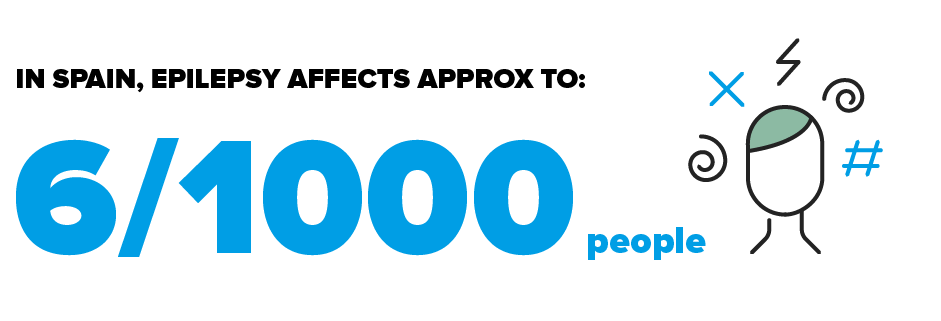
Epilepsy is one of the most common neurological disorders and affects approximately 0.5–1% of the general population. In Spain, 15 in every 1,000 people will have epilepsy at some time in their life. However, there are less individuals with active epilepsy, 5.7 in every 1,000 people.
Substantiated information by:

Published: 22 May 2018
Updated: 10 July 2025
Subscribe
Receive the latest updates related to this content.
Thank you for subscribing!
If this is the first time you subscribe you will receive a confirmation email, check your inbox