Symptoms of Glaucoma
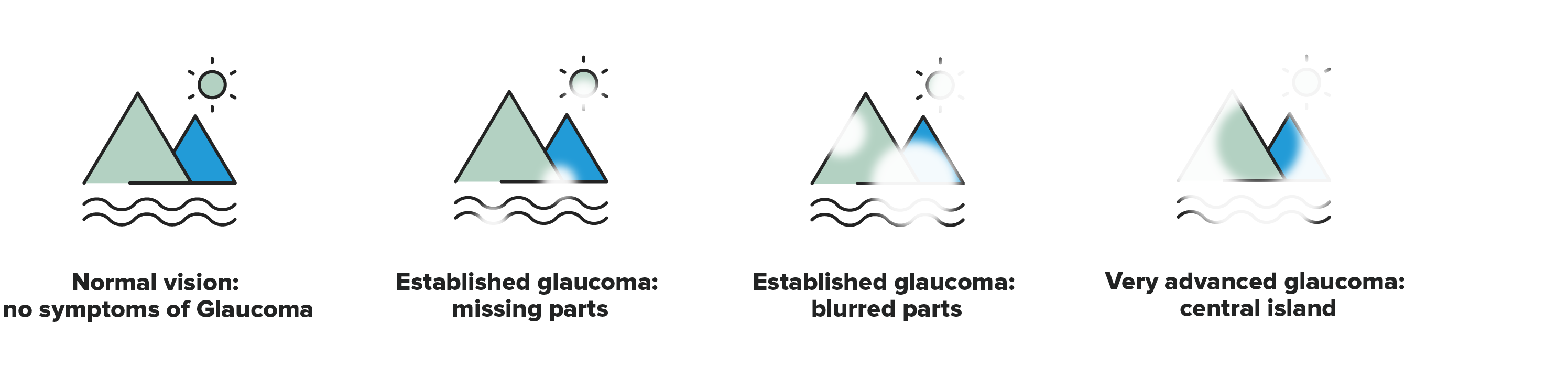
In most cases, glaucoma does not present any symptoms. The loss of peripheral vision it causes often goes unnoticed, especially in the early stages. This is because the brain can “fill in” missing parts of the image using information from surrounding areas or from the other eye, since in most cases the severity differs between the two eyes.
In mild cases of glaucoma, patients may sometimes notice increased clumsiness in daily activities that require good peripheral vision, such as difficulty going down stairs, bumping into objects at the sides, or even difficulty with reading. However, this is rarely attributed to vision loss and is more often thought to be a loss of agility related to ageing. Patients with glaucoma have a higher risk of falls (for example, a higher incidence of femur fractures) and are at higher risk of road traffic accidents.
It is not until advanced stages that patients become truly aware of their peripheral vision loss, experiencing what is commonly described as “tunnel vision” or “gun-barrel vision.”
An exception is angle-closure glaucoma, which in some cases can produce symptoms due to a sudden increase in intraocular pressure that the eye cannot compensate for. In these cases, patients experience a sudden onset of:

This is an emergency situation because if the pressure remains too high it can damage the nerve and have a severe effect on their vision.
Signs of Glaucoma
In the most common type of glaucoma (primary open-angle glaucoma), the external appearance of the eye is completely normal to the naked eye. On fundus examination, the normal optic nerve has a “donut-like” shape, with a central “hole” (the cup) and a surrounding circular area (the “dough” of the donut), which contains the nerve tissue. In patients with glaucoma, there is a loss of the optic nerve rim (the “dough”), causing the central cup to enlarge, until in advanced cases it appears as a large central crater due to the near-complete absence of nerve tissue.
In angle-closure glaucoma, when there is a sudden increase in pressure (an “attack”), the eye may appear red and, on external examination, a fixed dilated pupil can be observed compared to the other eye.
In congenital glaucoma, because children are still growing, the affected eye may enlarge and appear bigger than the other eye. In some cases, it may also appear whitish externally due to loss of corneal transparency caused by increased pressure.
Substantiated information by:


Published: 19 October 2018
Updated: 28 May 2026
Subscribe
Receive the latest updates related to this content.
Thank you for subscribing!
If this is the first time you subscribe you will receive a confirmation email, check your inbox
Glaucoma related news


30 November 2023
What are the most common eyelid diseases?

16 October 2023