What is Crohn’s disease?
Crohn’s disease is a chronic illness that differs from ulcerative colitis because it can affect any section of the digestive tract with inflammation occurring in all layers of the intestinal wall. It may affect discontinuous areas, i.e., the digestive tract contains alternating sections of healthy areas and inflamed segments.
ICrohn’s disease, as the inflammation affects the entire intestinal wall, can course with complications such as stenosis (reduction of the intestinal lumen) and/or fistulas (a connection between two intestinal loops or to an organ, e.g., the urinary bladder) which may be accompanied by intra-abdominal collections of pus (abscesses).
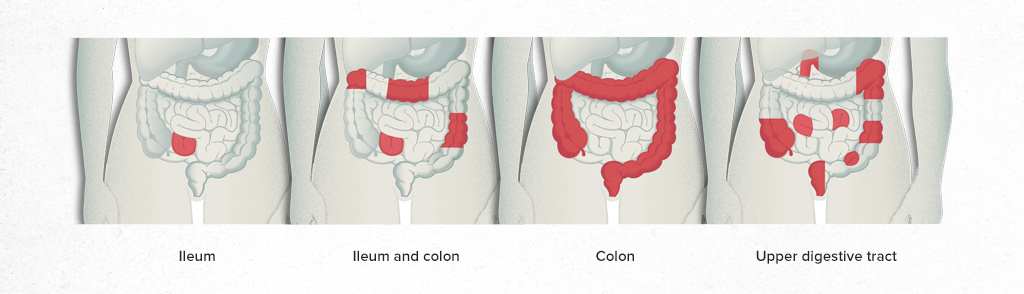
The most frequently affected areas are:
- Ileum. Predominantly the distal ileum.
- Colon. Any segment.
- Ileum and colon. Both simultaneity.
- Upper digestive tract. From the mouth to the proximal ileum.
Complications associated with Crohn’s disease
The main complications arising in conjunction with Crohn’s disease are:
- Intestinal obstruction caused by intestinal lumen reduction secondary to inflammation and/or the accumulation of fibrous scar tissue. The primary symptoms of this complication are abdominal pain (cramps) and general food intolerance (vomiting).
- Fistulas are abnormal passageways connecting two internal parts of the body. A perianal fistula is a connection between the anal canal and the perianal skin around the end of the anus.
Most frequent symptoms of Crohn's disease

Abdominal pain.

Diarrhoea.
Complications associated with diarrhoea
- Dehydration. Excessive loss of body water
- Loss of nutrients, water and electrolytes (sodium, potassium, magnesium, etc.)
In this case, oral rehydration therapy is essential. Administration of just water is not enough; patients must also receive the correct quantity of electrolytes (oral rehydration solution). In severe cases, fluids must be replaced intravenously.

Palpable abdominal mass on physical examination.

Nausea and/or vomiting.

Weight loss.

Fever (a sign of the condition’s severity).
Symptoms may vary depending on the disease’s location. When it affects the small intestine, patients primarily experience abdominal pain, diarrhoea, weight loss and/or loss of appetite. If the disease affects the colon, the predominant symptom is diarrhoea with or without blood and/or mucus.
Perianal disease
It is important to remember that Crohn’s disease can affect the anus and produce lesions such as:
- Skin tags: protruding or thickening (inflammation) of the skin around the anus.
- Fistulas: passageway from inside the rectum to outside the body (perianal skin).
- Abscess: accumulation of pus due to infection of the fistula.
- Fissure: small tear appearing as a linear wound in the anal canal.
- Rectal stenosis: narrowing of the anus or rectum because of scar tissue produced by ulcers.
Substantiated information by:


Published: 20 February 2018
Updated: 7 May 2025
Subscribe
Receive the latest updates related to this content.
Thank you for subscribing!
If this is the first time you subscribe you will receive a confirmation email, check your inbox


