What is Multiple Sclerosis?
Multiple sclerosis (MS) is a chronic inflammatory disease that affects the central nervous system (CNS). It causes inflammation that leads to small lesions in certain areas of the brain, called plaques. In these areas, there is a loss of myelin (demyelination), the protective layer that surrounds and insulates the nerves, together with relative preservation of the axon.
Multiple Sclerosis explained in first person
People with multiple sclerosis should understand that it is very important to continue then treatment even they don’t have any symptoms, because these medicines don’t treat the symptoms - they help prevent new attacks.
The experience, the years of research mean that we are learning more about it all the time, there are more treatments to manage it, so while it can’t be cured yet, we patients can still have as normal a life as possible.

The term "sclerosis" refers to the hardening (scarring) of the tissue within these plaques, whereas "multiple" reflects both the presence of multiple lesions throughout the central nervous system and the multiple episodes of neurological dysfunction that may occur during the course of the disease.
Anatomy of the nervous system
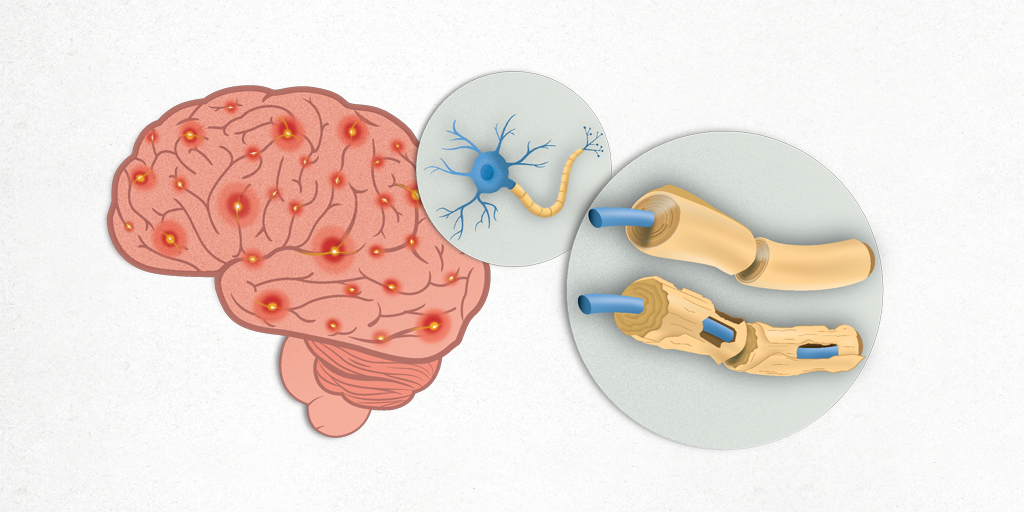
In very broad terms, the nervous system is divided into:
-
Central nervous system (CNS), which consists of the brain, brainstem, cerebellum, spinal cord and optic nerves.
-
Peripheral nervous system (PNS), which consists of the nerve roots and peripheral nerves once they emerge from the brainstem and spinal cord.
The main cellular component of the nervous system is the neuron, which consists of a cell body, one or more short extensions called dendrites, and a long extension called the axon.
Myelin is the sheath or covering that surrounds the axons, and oligodendrocytes are the cells that produce this sheath. Axons conduct nerve impulses, while myelin acts as an insulator and increases the speed of nerve impulse conduction.
Grey matter is the region of the CNS composed mainly of neuronal cell bodies and dendrites, whereas white matter is composed of axons (myelin is what gives it its white colour).
Types of multiple sclerosis
Multiple sclerosis is characterised by the appearance of episodes or flare-ups of neurological dysfunction that remains constant for 3-4 weeks and that are slowly recovered throughout the following month. It must always be a manifestation that does not coincide with a fever or any other state that could alter the general status.
These flare-ups do not always occur in the same way or with the same intensity, and may follow a different course. Based on these differences it may be considered that there are different sub-types of the disease.

Relapsing-remitting form. It is the most common form, with 8-9 of every 10 patients with multiple sclerosis having this progressive form. It is characterised by the appearance of episodes or flare-ups of neurological dysfunction from which the patient recovers completely or partially (thus the name remitting) and which are repeated every determined time (relapsing).

Secondary progressive form. The patients with relapsing remitting multiple sclerosis, after the first 15-20 years from the onset of the disease, enter a phase of gradual worsening of the neurological function, without being a result of a flare-up.

Primary progressive form. This affects around 1 in 10 patients and is characterised by a gradual deterioration in disability from the onset, without having flare-ups throughout the disease.

Progressive-relapsing form. It is less common. It is characterised by the constant progression of the disease since its onset, sometimes presenting during flare-ups.
For these patients that present with the disease in the first episode or flare-up, it is said that they suffer from a clinically isolated syndrome (CIS), which may not necessarily be a multiple sclerosis diagnosis.
How many people are affected by multiple sclerosis?
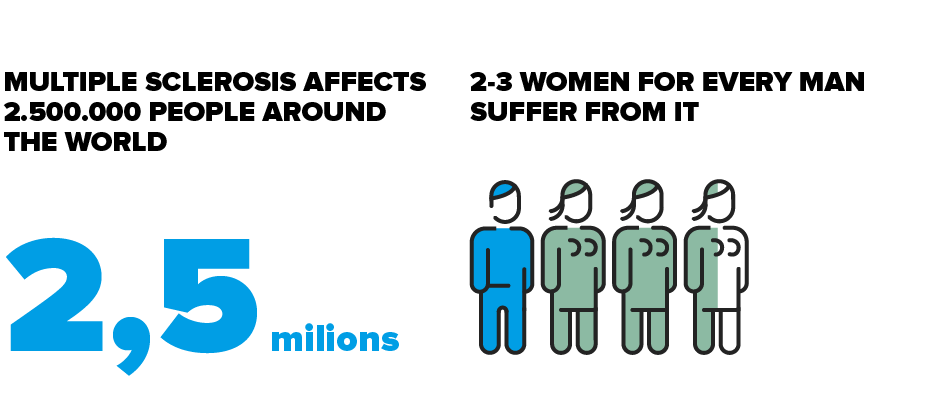
It is calculated that there are around 2.5 million people affected in the world. In the West, it is the most common chronic neurological disease in young adults. The frequency varies worldwide and appears to be influenced by a complex interaction between geographic location and genetic factors. Thus, it is more common between latitudes 40o and 60o north and south.
In Europe, the number of cases in the northern countries and the United Kingdom is around 2 for every 1,000 inhabitants, which is similar to that of the United States and Canada. In Spain, it is around 1 for every 1,000 inhabitants, which means that about 47,000 people are affected in our country. In Africa, Asia and South America, the disease is less common.
Multiple sclerosis can appear at any age, but it is rare before 10 years, and after 60 years. The average age of onset is at 30 years, with a first peak between 21 and 25 years, and another much lower one between 41 and 45 years. Multiple sclerosis affects women more frequently than men, with a female-to-male ratio of approximately 2–3:1. At older ages (over 45 years), this difference tends to become less pronounced.
Substantiated information by:


Published: 20 February 2018
Updated: 13 July 2026
Subscribe
Receive the latest updates related to this content.
Thank you for subscribing!
If this is the first time you subscribe you will receive a confirmation email, check your inbox


