Symptoms of Multiple Sclerosis
As the disease can affect any area of the CNS white matter, the range of possible symptoms is very broad, although most patients will experience only some of them. These symptoms may vary from one patient to another, and also in the same patient over the course of the disease.
They are usually manifestations that develop over a period of days, remain stable for 3–4 weeks, and gradually resolve over approximately the following month. This is known as a relapse, and it must always be a manifestation that does not occur in association with fever or any other condition that affects the person's general health.
In the relapsing forms of multiple sclerosis, the most common initial clinical presentations include:

Changes in visual acuity. Initially, there is usually eye pain, especially with eye movement, followed by gradual loss of vision and changes in colours (optic neuritis due to damage of the optic nerve).

Double vision (diplopia). It leads to the patient having to cover one eye or who has the sensation that the environment is moving (oscillopsia) due to brain stem involvement.
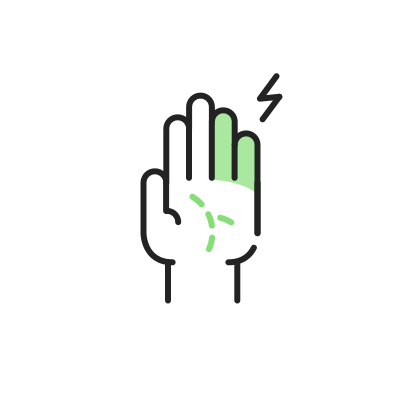
Sensory disorders. Tingling or reduced sensation in one or more limbs, which may be accompanied by a feeling of tightness around the trunk (like a band or girdle), due to a lesion in the spinal cord. Occasionally, it is a feeling of an electrical discharge in the back and limbs on flexing the neck (Lhermitte syndrome) produced by a lesion at spinal cord level, or painful electrical discharges located in any part of the face (trigeminal neuralgia), due to a brain stem lesion.
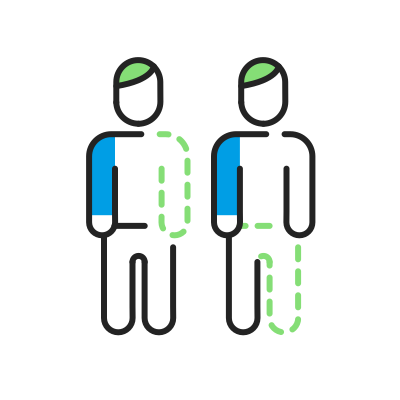
Motor disorders. Weakness in one or more limbs, either in isolation or associated with sensory disturbances in the same areas, due to involvement of the brain or spinal cord.
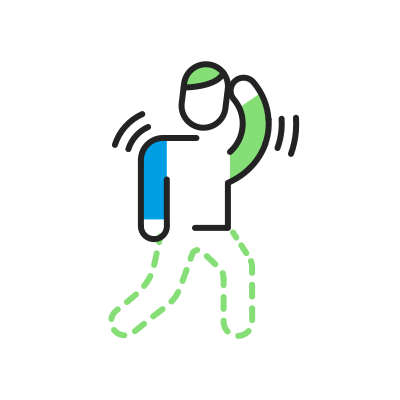
Ataxia. Difficulty coordinating limb movements or unsteady gait. Occasionally, there is a feeling of vertigo and difficulty in articulating words.

Other, much less common initial presentations, which usually occur in isolation, include sphincter dysfunction and cognitive problems.
In the progressive forms, the most usual clinical presentations are:
Weakness in both legs disorder (paraparesis). It is often an asymmetric weakness and is usually accompanied by sensory changes. With time, there are sphincter changes (mainly urinary).
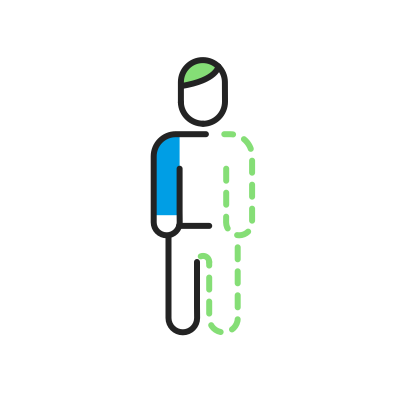
Hemiparesis. Weakness affects the arm and leg on the same side of the body, although one limb is usually more severely affected than the other. This can also be accompanied by sensory changes.
Ataxia. Difficulty coordinating limb movements or unsteady gait. Occasionally, there is a feeling of vertigo and difficulty in articulating words.

Progressive cognitive impairment. This is a much less common presentation and consists of cognitive decline developing over a relatively short period of time (1–2 years).
Involvement of various neurological functional systems. Despite the fact that different neurological functional systems (motor, sensory, cerebellar, brain stem, visual, sphincters, sexual, and mental) may be affected during the course of the disease, only in the most advanced cases are there changes that involve a combination of several of these functional systems.

Cognitive impairment. During the course of the disease, difficulties with attention or planning abilities may develop. However, impairments in memory, language, and executive functions related to temporal sequencing are uncommon.

Fatigue. Of unknown cause, it is not associated with the inflammatory activity of the disease. The affective disorders such as anxiety, depression, and sleep problems have a negative impact on fatigue.
Among the possible symptoms throughout the course of the disease, gait disturbance is one of the patients' main complaints. Its cause is usually multifactorial and may be related to weakness, spasticity, impaired coordination, sensory disturbances, and may also be influenced by fatigue.
Substantiated information by:


Published: 20 February 2018
Updated: 13 July 2026
Subscribe
Receive the latest updates related to this content.
Thank you for subscribing!
If this is the first time you subscribe you will receive a confirmation email, check your inbox


