

20 January 2026
PortalClinic home
Joint project with
BBVA Foundation website.This link opens in a new tab.
What is alopecia?
Reading time: 2 min
Alopecia is a disorder characterised by the loss of hair on the head, eyebrows, eyelashes, beard or other areas of the body. It can be partial or total and occurs due to a disruption in the natural hair growth cycle (hair follicle).
Alopecia explained in first person
Professionals and patients explain how you live with the disease

Hair grows from a structure in the skin called a hair follicle, which acts as a small "factory" located in the scalp. Follicles are not usually isolated but organised into groups called follicular units. Each follicular unit contains between one and four hairs that emerge in close proximity through the skin. The hairs share associated structures, including a sebaceous gland, the arrector pili muscle and a vascular network.
These units and the characteristics of the hairs they contain determine the density and natural appearance of the hair. Alopecia occurs when there is a disruption in the natural hair growth cycle.
Hair growth cycle
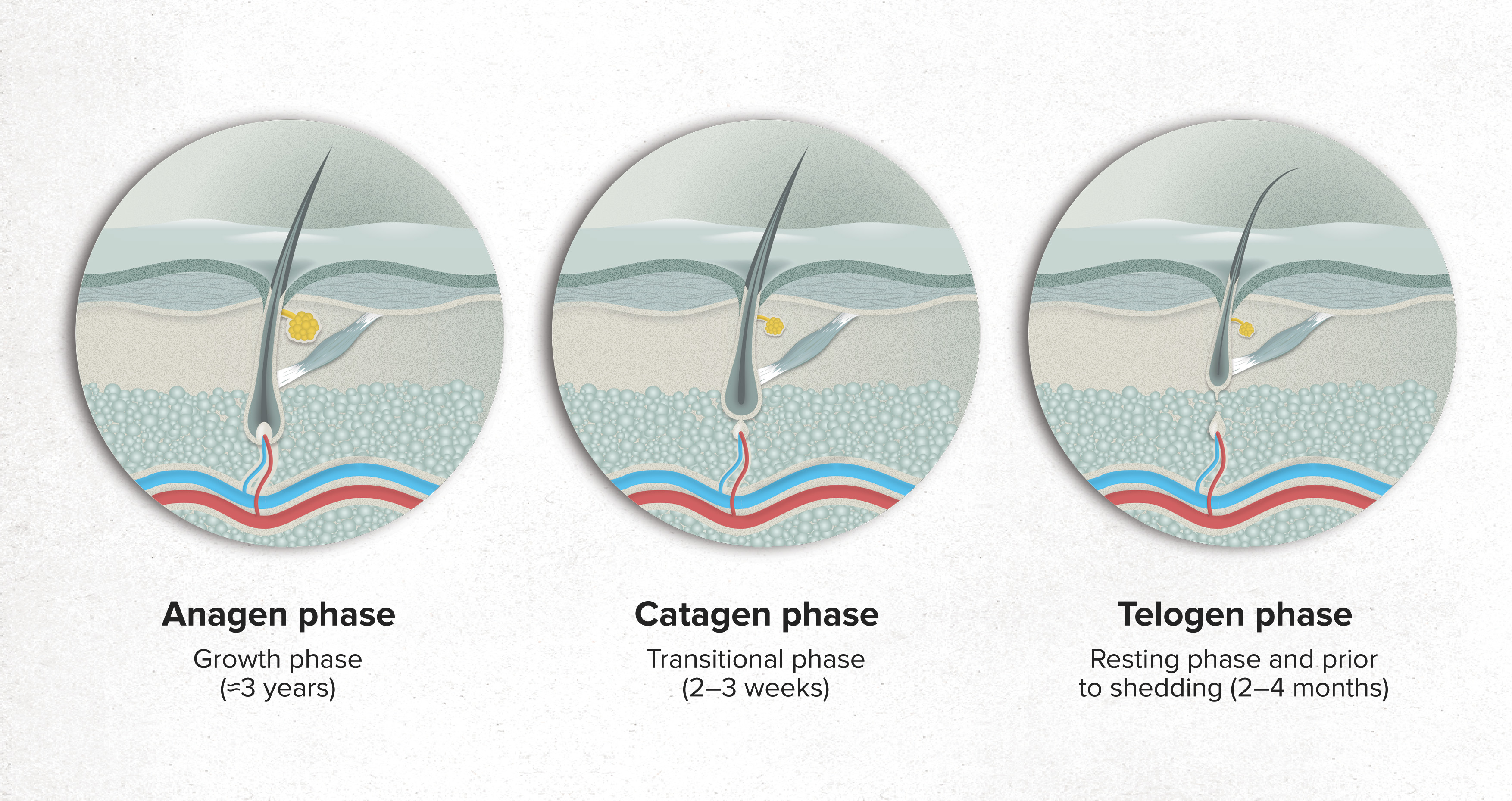
Hair growth, or the hair cycle, comprises several phases: growth (anagen), involution or transition phase (catagen) and resting phase (telogen), before the hair sheds and new hair growth begins from the same follicle. If this process does not function correctly—due to genetic, hormonal, immunological, inflammatory, metabolic or environmental factors—the hair shaft can become thinner (thinning), fall out in greater quantities or stop growing altogether (miniaturisation).
Image: Anagen. Growth phase – 3 years; Catagen. Transition phase – 2-3 weeks; Telogen. Resting phase preceding hair shedding– 2-4 months
Although alopecia is often experienced as a cosmetic problem, it can also be a sign that something is happening in the body. Furthermore, hair loss can significantly affect self-esteem, emotional well-being and social relationships.
Therefore, it is important to study each case individually. Diagnosis usually includes a detailed medical evaluation and, in some cases, specific tests or blood analysis. Treatment is tailored to each individual based on the type of alopecia, its cause, severity and how it affects the quality of life.
How many people are affected by alopecia?
Hair loss is an extremely common phenomenon. Throughout their life, virtually everyone will notice changes in hair density: it may become thinner, less voluminous and grow more slowly.
Types of Alopecia
Alopecia is generally classified into two main categories:
- Non-scarring alopecia: when the hair follicle remains viable and hair can regrow. This type includes:
- Androgenetic alopecia (male pattern)
- Androgenetic alopecia (female pattern)
- Alopecia areata (autoimmune)
- Telogen effluvium
- Anagen effluvium (e.g., post-chemotherapy)
- Scarring alopecia: when a chronic inflammatory process leads to fibrosis and irreversible destruction of the hair follicle. This type includes:
- Frontal fibrosing alopecia
- Other scarring alopecias (e.g., lichen planopilaris, folliculitis decalvans, cutaneous lupus erythematosus and central centrifugal cicatricial alopecia)
PortalClinic home
Joint project with
BBVA Foundation website.This link opens in a new tab.
Sorry this content wasn't helpful to you. Send us your comment and we will take it into account to continue improving.
Thanks for your help!
An error has occurred and we were unable to send your opinion, please try again later.
Substantiated information by:
Andrea Combalía
Dermatologist
Dermatology Department
Published: 13 May 2026
Updated: 13 May 2026
The donations that can be done through this webpage are exclusively for the benefit of Hospital Clínic of Barcelona through Fundació Clínic per a la Recerca Biomèdica and not for BBVA Foundation, entity that collaborates with the project of PortalClínic.
Subscribe
Receive the latest updates related to this content.
Thank you for subscribing!
If this is the first time you subscribe you will receive a confirmation email, check your inbox
An error occurred and we were unable to send your data, please try again later.