

20 January 2026
PortalClinic home
Joint project with
BBVA Foundation website.This link opens in a new tab.
Androgenetic alopecia (male pattern)
Reading time: 2 min
What is male androgenetic alopecia?
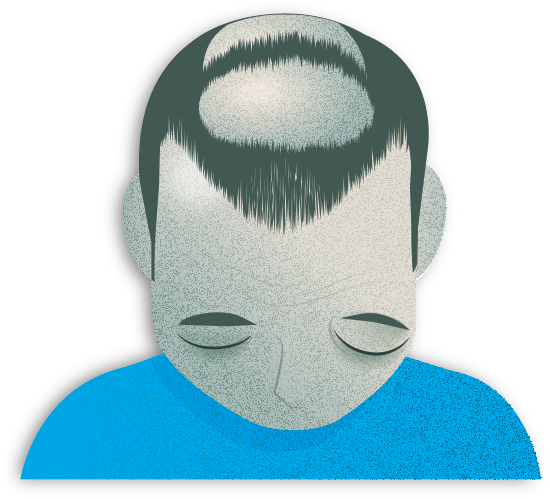
Male androgenetic alopecia is a type of non-scarring alopecia characterised by progressive hair thinning, particularly at the temples (frontotemporal regions) and the crown (vertex), as described in the Hamilton–Norwood classification. It is the most common form of alopecia in men, and it is estimated that more than 50% will develop this type of alopecia from around age 30, with its frequency increasing with age.
Signs and symptoms of male androgenetic alopecia
The signs of male androgenetic alopecia include progressive recession of the frontal hairline, hair thinning and reduced density in the upper scalp and crown. In more advanced stages, areas of marked hair loss appear in the frontal and superior regions, while hair is generally preserved on the sides and at the nape of the neck.
Causes of male androgenetic alopecia
Male androgenetic alopecia is caused by the action of male hormones (androgens—particularly dihydrotestosterone) on hair follicles in individuals with a genetic predisposition.
A family history is one of the main risk factors.
Diagnosis of male androgenetic alopecia
Male androgenetic alopecia is diagnosed through clinical examination by a specialist, based on observation of the scalp. Trichoscopy is used to confirm the diagnosis. This test allows assessment of variability in hair shaft thickness, an increased number of miniaturised follicles, reduced hair density and the presence of follicular units containing fewer hairs.
Although this type of alopecia is associated with hair ageing, its accelerated progression and its functional and aesthetic impact on the patient justify treatment.
Treatment of male androgenetic alopecia
Treatment includes topical or oral therapies that help slow hair loss and strengthen the hair (e.g. topical or oral minoxidil); medications that reduce the action of certain hormones (topical and systemic antiandrogens such as finasteride and dutasteride); as well as complementary therapies aimed at improving follicular quality (e.g., mesotherapy and platelet-rich plasma). In selected cases, hair transplantation may also be considered as a reconstructive option.
PortalClinic home
Joint project with
BBVA Foundation website.This link opens in a new tab.
Sorry this content wasn't helpful to you. Send us your comment and we will take it into account to continue improving.
Thanks for your help!
An error has occurred and we were unable to send your opinion, please try again later.
Substantiated information by:
Andrea Combalía
Dermatologist
Dermatology Department
Published: 13 May 2026
Updated: 13 May 2026
The donations that can be done through this webpage are exclusively for the benefit of Hospital Clínic of Barcelona through Fundació Clínic per a la Recerca Biomèdica and not for BBVA Foundation, entity that collaborates with the project of PortalClínic.
Subscribe
Receive the latest updates related to this content.
Thank you for subscribing!
If this is the first time you subscribe you will receive a confirmation email, check your inbox
An error occurred and we were unable to send your data, please try again later.