

20 January 2026
PortalClinic home
Joint project with
BBVA Foundation website.This link opens in a new tab.
Other scarring alopecias
Reading time: 2 min
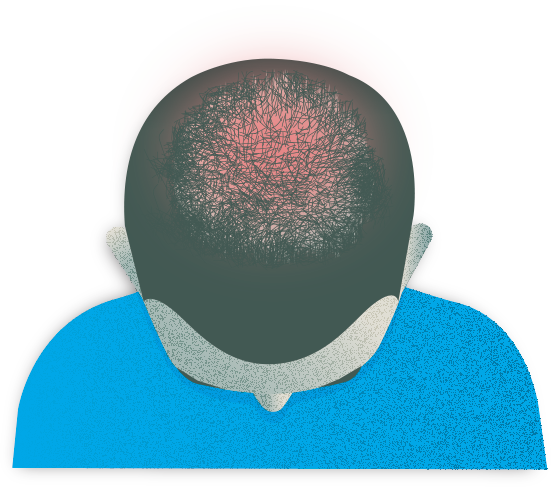
This group of alopecias includes disorders such as lichen planopilaris, folliculitis decalvans, cutaneous lupus erythematosus and central centrifugal cicatricial alopecia, which share a common outcome: irreversible destruction of the hair follicle.
Signs and symptoms of scarring alopecias
These alopecias occur as areas of hair loss accompanied by local inflammatory signs such as:
- Skin redness (erythema).
- Perifollicular scaling.
- Small pus-filled lesions (pustules).
- Pain or discomfort.
Although exact symptoms depend on the type of alopecia.
Over time, if inflammation persists, the skin in the affected area becomes smooth and thin, and the follicles disappear as scar tissue (fibrosis) forms. This is what prevents hair from regrowing.
Given their scarring nature, early detection is essential to prevent further permanent hair loss.
Causes of scarring alopecias
The causes are diverse and include immune system disorders, disturbances in the skin’s natural flora (microbiome), chronic infections, hormonal imbalances and genetic predisposition, although in many cases the exact cause remains unclear.
Diagnosis of scarring alopecias
Trichoscopy is a key tool for identifying characteristic findings such as:
- Absence of visible follicular openings.
- Accumulation of cells and keratin around the follicle (perifollicular hyperkeratosis).
- Skin debris and sebum obstructing the follicles (keratin plugs).
- Arborising blood vessels.
- Broken hairs or signs of inflammatory activity.
These findings help identify the specific subtype of alopecia and the degree of disease activity.
Treatment of scarring alopecias
As scarring alopecias, the lost hair does not regrow, making it crucial to seek medical advice at the first signs of eyebrow or hair loss, so treatment can be started as early as possible to prevent progression.
PortalClinic home
Joint project with
BBVA Foundation website.This link opens in a new tab.
Sorry this content wasn't helpful to you. Send us your comment and we will take it into account to continue improving.
Thanks for your help!
An error has occurred and we were unable to send your opinion, please try again later.
Substantiated information by:
Andrea Combalía
Dermatologist
Dermatology Department
Published: 13 May 2026
Updated: 13 May 2026
The donations that can be done through this webpage are exclusively for the benefit of Hospital Clínic of Barcelona through Fundació Clínic per a la Recerca Biomèdica and not for BBVA Foundation, entity that collaborates with the project of PortalClínic.
Subscribe
Receive the latest updates related to this content.
Thank you for subscribing!
If this is the first time you subscribe you will receive a confirmation email, check your inbox
An error occurred and we were unable to send your data, please try again later.